
Beyond the Datasheet: What Actually Determines the Right Glass-Filled Flame-Retardant Polycarbonate Grade?
When engineers compare engineering plastics, the conversation often begins with the datasheet. Glass fiber percentage, melt flow rate, UL94 rating, and heat deflection temperature are all valuable specifications, but they rarely answer the most important question:
Will this material perform reliably in my application?
Two polycarbonate grades with similar specifications can behave very differently during molding and throughout the product’s service life. That’s why experienced buyers and design engineers look beyond individual numbers and evaluate the complete material formulation before choosing a PC glass filled granules supplier.
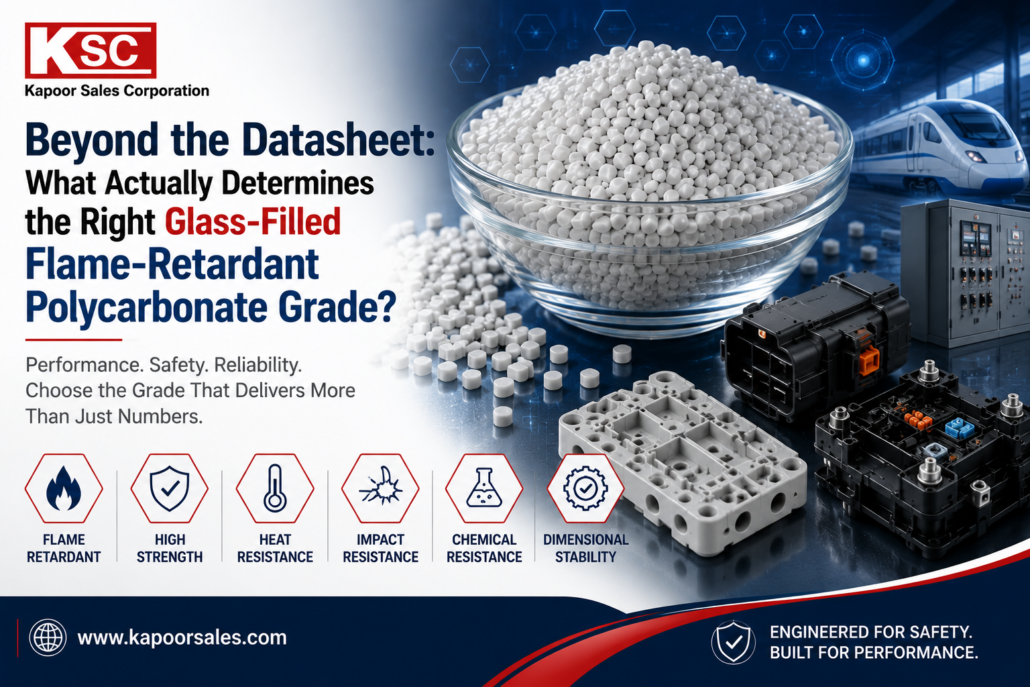
A Material Grade Is a Combination of Properties, Not a Single Number
Glass-filled flame-retardant polycarbonate is designed to solve multiple engineering challenges at once. The goal is rarely to maximize one property. Instead, manufacturers balance mechanical strength, flame resistance, dimensional stability, processing characteristics, and long-term durability.
Before shortlisting a material, it helps to identify what the component actually demands.
| Design Consideration | Why It Should Influence Material Selection |
|---|---|
| Structural stiffness | Prevents deformation in load-bearing components. |
| Flame retardancy | Supports safety standards for electrical and industrial products. |
| UV exposure | Maintains performance in outdoor installations. |
| Mold complexity | Influences filling, cooling, and cycle consistency. |
| Dimensional accuracy | Reduces warpage and assembly issues. |
| Production efficiency | Affects cycle time, reject rates, and tooling performance. |
Selecting a material based only on one specification often leads to compromises elsewhere in the manufacturing process.
Glass Fiber Percentage Is Only Part of the Story
A common misconception is that increasing glass fiber automatically creates a better engineering material. While reinforcement improves stiffness and dimensional stability, the “best” percentage depends entirely on the application.
| Glass Fiber Level | Typical Design Objective | Commercial Grade Examples |
|---|---|---|
| 10% GF | Balance stiffness with processability | 500R, 505R, 505RU |
| 20% GF | Higher rigidity and dimensional stability | 3412ECR, 3412R |
| 30% GF | Structural parts carrying greater loads | 3413HF, 3413R |
For instance, 3412ECR combines 20% glass fiber with mold-release additives and non-chlorinated, non-brominated flame-retardant chemistry while achieving UL94 V-0 and 5VA performance. Those combined characteristics often matter more than the reinforcement percentage alone because they influence both manufacturing efficiency and finished-part performance.
Similarly, 3413HF and 3413R increase stiffness through 30% glass reinforcement, making them suitable for industrial assemblies where reduced deflection is more important than maximizing impact resistance.
Fire Performance Should Be Evaluated in Context
Many buyers begin material selection by comparing UL94 ratings. While essential, fire performance is only one requirement in a broader engineering decision.
Modern electrical products frequently require materials that combine flame retardancy with environmental considerations, UV stability, and reliable processing characteristics. Grades such as 505RU, 525RU, and 945U illustrate how today’s PC glass filled resin formulations are engineered to satisfy multiple design priorities rather than focusing solely on fire classification.
Processing Performance Often Determines Manufacturing Success
A material that performs well in the field must also perform consistently inside the mold.
As wall sections become thinner and part geometries more complex, melt flow, mold release, shrinkage control, and dimensional consistency become increasingly important. Thin-wall grades including 3412ECR, 515RU, BFL2015, and ML3019 are developed to improve cavity filling while maintaining the mechanical and flame-retardant properties expected from PC glass filled granules for industrial applications.
In many production environments, these processing advantages can reduce rejects, improve repeatability, and support higher manufacturing efficiency without changing the overall product design.
Selecting the Right Grade Starts with the End Use
Instead of asking which grade has the highest specification, a more effective question is which formulation best matches the application’s operating conditions.
| If your priority is… | Consider Grades Such As… |
|---|---|
| Balanced performance | 500R, 505R |
| Improved dimensional stability | 3412ECR, 3412R |
| Structural rigidity | 3413HF, 3413R |
| Outdoor electrical components | 503R, 505RU |
| Non-halogen flame retardancy | 3412ECR, 505RU, 525RU, 945U |
| Thin-wall molding | 3412ECR, 515RU, BFL2015, ML3019 |
The strongest material is not always the most suitable one. The best choice is the formulation that balances structural performance, flame resistance, processability, and long-term reliability for the intended application. Working with an experienced PC glass filled granules supplier also provides access to a broader portfolio of glass filled polycarbonate grades, making it easier to identify a material that meets both engineering and manufacturing objectives rather than simply matching a specification sheet.